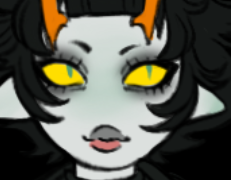


☼ I made that post knowing fully I was already going to make this post| I just wanted to catch your eye| #Triggers for #Death #Sun-Death and #Fashion| ☼ ☼ Sun-Death Makeup is frequently mistaken for ordinary mourning paint or subjuggulator flair, particularly by those who have only ever seen the cheaper imitations of it at Light Clubs| This is understandable, but a falsity I must correct| ☼ ☼ The style originated among jadebloods who worked close enough to the surface that exposure to daylight was an occupational reality rather than a theoretical one| While most castes treated the sun as something between a hazard and a death sentence, jadebloods could survive considerably greater exposure| On average, anyhow| ☼ ☼ Of course, someone turned this suffering into fashion| After all, we know that's what beauty is at the end of the day| The earliest Sun-Death looks were not especially elaborate| Pale mineral powders were applied heavily across the face to imitate skin bleached by prolonged sunlight, while black pigment was concentrated around the eyes, mouth, and other recessed portions of the face| The intended effect was not simply "corpse-like|" Alternian corpses do not conveniently turn white| The wearer was instead meant to resemble something found after having been left on the surface too long: drained of recognizable coloration, scorched at the extremities, and preserved in the very thing that ought to have destroyed it| ☼ ☼ White is exposure, black is charring, shadow, and burnt tissue, and jade represents what remains alive underneath it| The latter is used sparingly, usually| Thin lines of caste colors might be drawn at the temples, beneath the eyes, around the lips, suggesting blood vessels visible through damaged skins| Later styles exaggerated these markings into cracks, branching capillaries, or deliberately exposed patches of gray and green beneath the white| ☼ ☼ As Sun-Death moved away from the caverns, the style diversified considerably| Some practitioners favored solar imagery: halos, radial lines, sharp white brows, or black circles surrounding the eyes like eclipses| Others leaned into the jadeblood association with brooding caverns and incorporated skeletal patterns, insectile segmentation, mandible shapes, pupal shells, and the anatomy of subterranean fauna| ☼ ☼ Rainbow drinkers complicated the fashion almost immediately| See, a glowing jadeblood wearing matte black and white Sun-Death makeup produces an effect ordinary cosmetics simply can't reproduce| Light catches beneath the pale sections while the black remains completely dead| This is giving the impression that the wearer is illuminated from inside a corpse| This is why older photographs of genuine rainbow-drinker Sun-Death are so frequently disappointing| The camera does not understand what it is looking at and fails to accomodate| ☼ ☼ Modern Sun-Death ranges from historically informed recreations to people smearing black pigment around their eyes before going to a concert and claiming lineage they have not researched| I am not interested in adjudicating the latter| I am interested in preventing you from looking terrible| ☼ ☼ For a basic traditional look, begin with a clean face| ☼ ☼ Apply a pale foundation or cosmetic powder considerably lighter than your natural gray| Do not attempt to achieve smooth, healthy-looking skin| Sun-Death is not beauty makeup| Slight unevenness improves the effect, particularly around the forehead, cheekbones, and jaw| You are imitating bleaching, not porcelain| ☼ ☼ Next, darken the eyes| Black pigment should extend beyond the eyelids and into the sockets| Follow the natural hollow of the eye rather than drawing a decorative circle| The easiest beginner mistake is making two symmetrical holes| A body exposed to the sun does not scorch according to your design principles! llow one side to rise slightly higher or descend farther beneath the eye| ☼ ☼ The mouth should be treated more carefully| A fully black lip is acceptable, but older styles usually concentrated pigment at the center of the mouth and allowed it to feather outward into cracks or staining| Extending thin black lines into the corners produces a particularly severe expression without making you look like a wriggler attempting clown paint| ☼ ☼ After that comes the caste color| Usually jade given the tradition| ☼ ☼ Use a small amount| Draw one or two thin jade lines beneath the skin: along a temple, from the lower eyelid toward the cheek, underneath the jaw, or down the throat| Branch them irregularly| They should suggest vessels, fractures, or something attempting to emerge through the damaged surface| If you wish to imitate scorching, add black lightly to the edges of the white areas, namely around the hairline, ears, nose, and jaw| ☼ ☼ Blend poorly on purpose| Do not cover your horns with the makeup unless you know what you're doing| Don't put the pigment in your eyes| Don't use actual ash| Don't expose yourself to sunlight to "make it authentic|" I cannot believe that final instruction requires inclusion, but historical precedent insists otherwise| ☼ ☼ Once you understand the basic form, you may begin adding personal variations| Solar halos, eclipses, cavern motifs, skeletal lines, insectile structures, ritual markings, artificial cracking, or controlled glow effects are all recognizable descendants of Sun-Death| ☼ ☼ The most important rule is that the face should tell the same story from a distance| ☼ ☼ Something walked into the daylight| ☼ ☼ Something remained there| ☼ ☼ Something came back| ☼