
I was quite excitedly informed by my dear wife about the new update. I must say, I do very much enjoy the way it looks. A visual representation of the connections made through the site is quite the addition!
Due to my speciality however, I do feel as though I must relate it to some real science. Initially, I considered relating it to comets. After some deliberation, I find it more apt to relate it to pulsars. While not a direct mirroring of the visual connections, I believe it would be the closest.
Pulsars are neutron stars -- incredibly dense remnants of dead stars that have collapsed in on themselves. These stars rotate rapidly on their axis, blasting out large swathes of radiation that typically originate from the star's magnetic poles. They also typically have incredibly strong magnetic fields. Strong enough to warp imaging.
The aforementioned 'beams' of radiation are typically very difficult to be seen, given that the number of pulsars visible through imaging equipment unblocked by other celestial bodies are rather few and far between. Further, the 'beams' of radiation are incredibly narrow with the large distance between star and imager, making it harder still to pinpoint them in many cases. Often, one must wait for a beam of radiation to 'sweep' past the imager's planet for one to be seen.
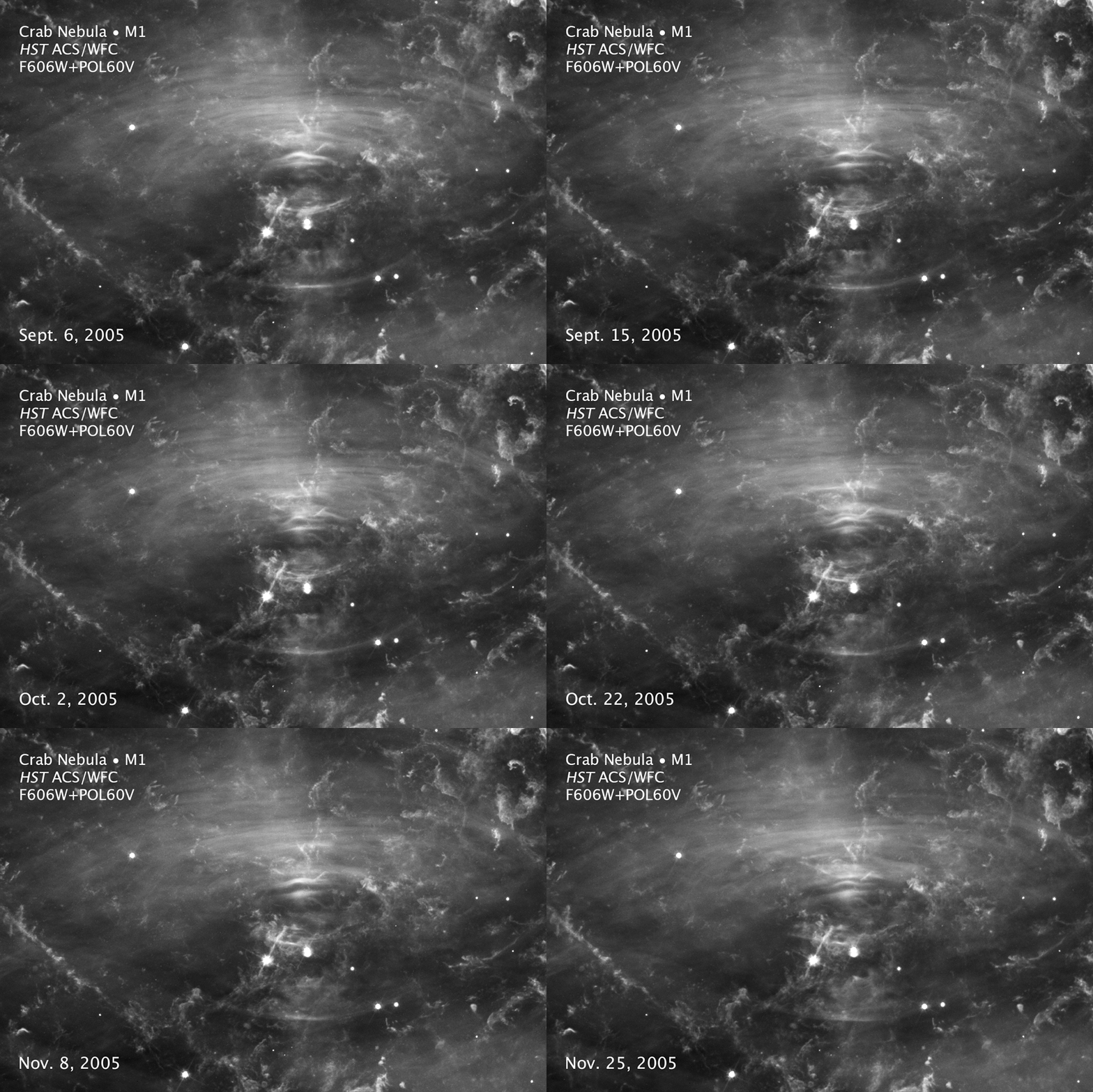
Nonetheless, in 2005 on Earth, the Hubble Space Telescope captured a series of images featuring the heart of the Crab Nebula and therefore a pulsar deep within, providing a fascinating time-lapse of the magnetisation the pulsar is radiating!
Kult: +100
Kull: +55
Total: 155
Ratio: 1.82