
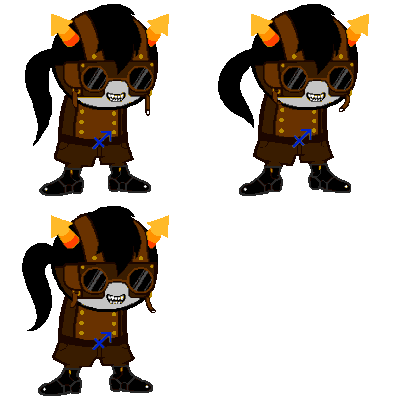
Horuss Zahhak


@canteringTackwork
8=D < You canter be serious. 8=| < Do you know how saddle be if they cancel the Bareback Rodeo four sweeps in a row due to 'malicious' partakers? 8'=[ < E%tremely.

8=D < How many of us can there be?

8=D < Progress upon the latest mechanical draft is steady. I have 100bed the joints, corrected several shameful tolerances, and resisted the urge to rebuild the entire thing from scratch.
8=D < Keep my tag off of your posts.
8=D < Neighbe the Boy's Night was the distraction I needed. I am resolved to working on my ne%t neighborly guide to Pony Play.
8=D < 🐴 Horsle 🐴 🟩🟩🟩🟩🟩 https://cabletwo.net/horsle
8=D < At toy's night. Thanks @caligulaAscendit.

8=D < Hello!
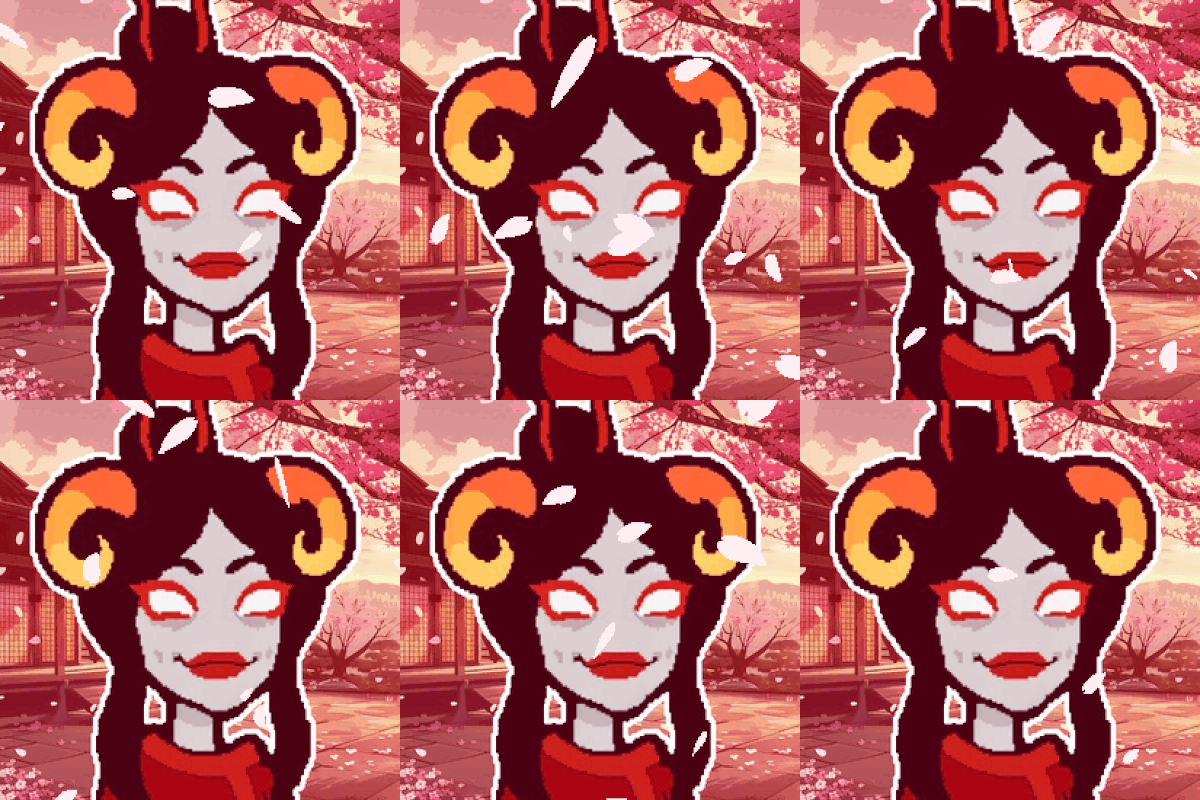
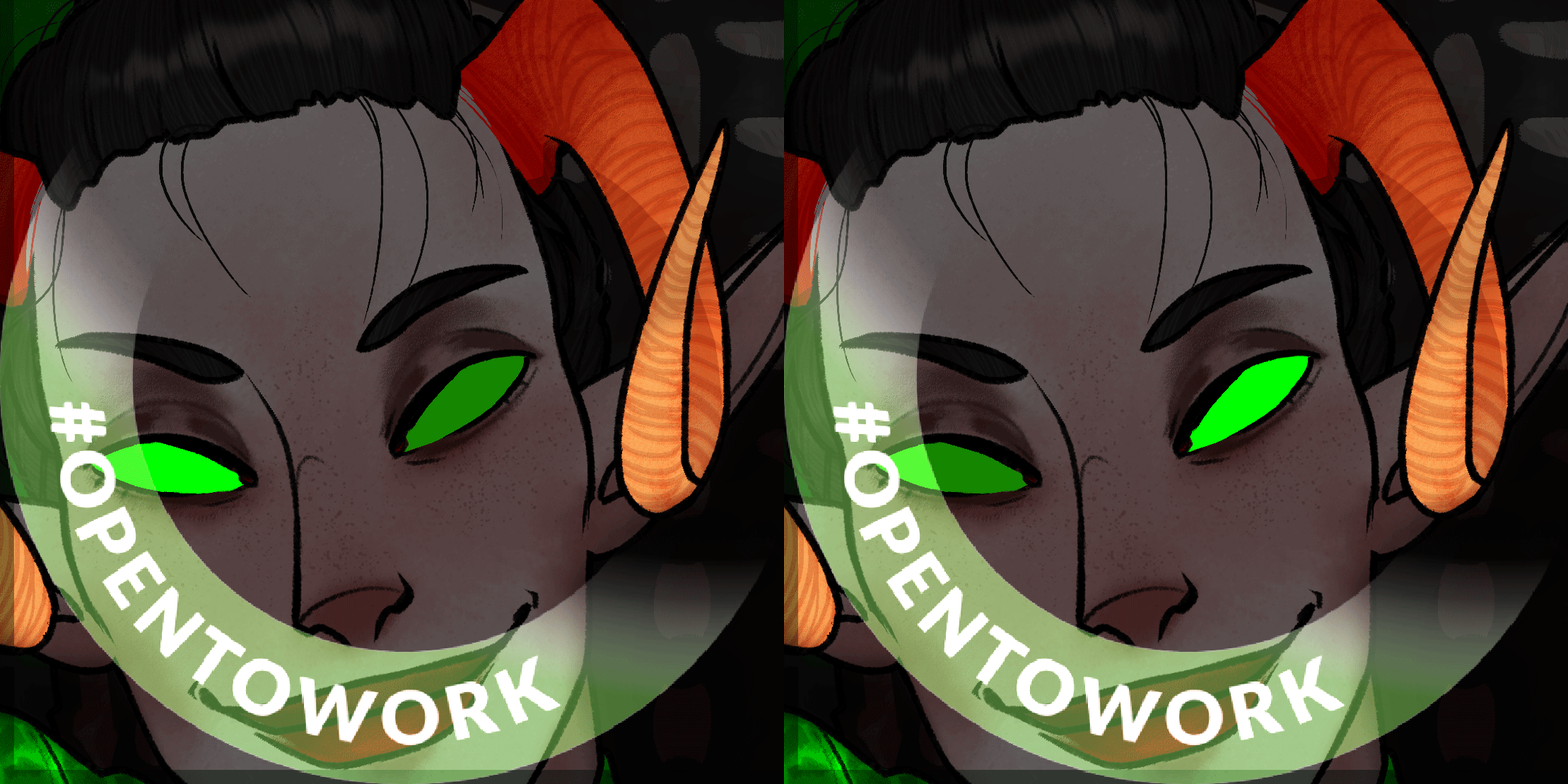
8=D < Twice... https://cdn.imgchest.com/files/fc4b4f15069a.png



8=D < ASCL?
8=D < How could that f100zy do this to me? 8=| < I am ruined. https://cdn.imgchest.com/files/33a023669758.jpg


8=D < Neigh. I shan't.
8=D < Filthy.

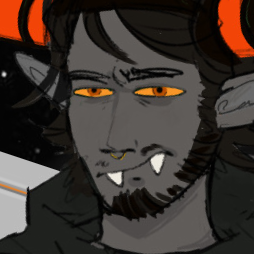
8=D < A MOST NECESSARY GUIDE TO TACK, HARNESS, AND THE DIGNITY OF PROPERLY FITTED EQUIPMENT As Written By Horuss Zahhak, Who Has Seen Too Many Tragic Straps And Will Remain Silent No Longer There comes a time in every stable’s life when someone must stand before the assembled herd, clear his throat with immense and justified gravity, and say the difficult thing. Some of you wear your tack like you're actual ponies putting it on. Remember, this is not simply a concern with your aesthetics. Though, your aesthetic is e%tremely damaged. This is your safety. Your comfort, dignity, function, and symbolism are contained within your respect for the noble equine arts. Tack is not some random decoration. A harness is not a series of random straps. The bridle is more than an e%cuse to put buckles upon your visage. Proper tack is communication. It communicates to the room what role you are entering, what level for formality you are observing, what care has been taken, and the competence of your practical fantasy. Improper tack, by contrast, tells the room that someone is a f001ish foal who has no craftsmen in their lives. I can fi% that for a fee. Let us begin with the first principle: equipment must serve the body before it serves the eye. A piece may be beautiful, e%pensive, handmade, imported, polished, dyed, engraved, bell-hung, ribboned, lacquered, or praised by every lowb100d handler you could imagine in the forum threads you peruse. But, if it pinches, slips, pulls, overheats, restricts circulation, interferes with your balance, or forces you into an unsafe position, it is a poor fit. Beauty does not substitute safety. Indeed, poor fit is the enemy of beauty. A pony cannot carry themselves proudly while secretly negotiating with a strap that is sawing into their shoulder like a tiny leather legislacerator. A handler cannot appear competent while their pony’s gear creeps sideways with every step. A groom cannot claim refinement while ignoring buckles biting into skin, twisted straps, uneven tension, or dangling ornaments positioned like they are attempting sabotage. Tack is care made visible. This is why every responsible stable must learn the sacred sequence: inspect, fit, check, move, recheck, and remove with attention. Inspect the equipment before it touches the body. Fit it calmly. Check pressure points. Ask the wearer how it feels. Have them move. Recheck after movement. Our bodies are scandalous scanty things with dynamic movement. They enjoy migrating straps into unfamiliar territory. Finally, remove gear with the same respect used to put it on. Do not simply peel someone out of their presentation like an impatient mechanic e%tracting a part from a wreck. The donning of tack is part of the ritual. So is its removal. A harness, properly fitted, should distribute pressure in a way that supports posture without punishing the wearer. It should sit evenly. It should not twist. It should not drag the body into a shape the wearer did not agree to inhabit. Decorative elements should not become hazards. Bells, ribbons, tags, rings, chains, buckles, and charms are splendid when placed intelligently and absurd when placed where they snag, swing into sensitive areas, or produce a soundscape resembling a cutlery drawer falling downstairs. Reins, if used, demand particular respect. They are not handles for yanking. They are not trophies. They are not conversational props for strangers. Reins imply trust, guidance, and agreed communication. To hold them is to accept responsibility, not to acquire a decorative e%tension of your ego. If you cannot guide with subtlety, you do not deserve reins. A bridle or headpiece should be treated with equal seriousness. Anything near the face, jaw, mouth, neck, or head requires heightened caution. The face is e%pressive, vulnerable, and socially significant. A person wearing a headpiece may be deeply in role, but they are still a person with breathing, sight, hearing, speech, comfort, and personal boundaries. The neck, I must add, is not a convenient place to store your lack of planning. Collars, chokers, posture pieces, and decorative throat straps require careful fit and constant awareness. A piece can 100k e%quisite and still be unsuitable for long wear, active movement, heat, crowded events, or a pony who intends to prance with the theatrical intensity of a creature recently freed to engage in their nightly liberties. Know the difference between posing gear, performance gear, and practical movement gear. This distinction is vital. Some tack is for photographs. Some is for ceremony. Some is for walking, pulling, dancing, kneeling, standing, or performing routines. Some is purely symbolic. Do not make assumptions. Do not mistake categories. The stable that fails to distinguish between display and function will eventually learn the difference in the least graceful way possible. If you are unfamiliar with stables, read my other ponyplay guide for prancing ponies. No one is too elegant to practice walking. Boots, heels, hooves, platforms, cuffs, and leg pieces can transform carriage beautifully, but they also change balance, gait, strain, and fatigue. Tails and ears are often treated as playful accessories, but even they require manners. Whether they are integrated into a harness, attached to clothing, decorative, functioning, moving, or simply part of the silhouette; they are not YOURS to tug. Do not flick them. Do not adjust them. Do not mistake their cuteness for consent to belittle the beast. The more adorable the pony, the more disciplined your behavior must become. A properly equipped pony should feel more themselves in role, not less safe in their body. Tack should help them enter the desired state: proud, calm, obedient, spirited, glamorous, useful, mischievous, disciplined, wild, ceremonial, or treasured. The e%act feeling depends on the pony. The duty of equipment is to support that transformation. There is no universal permission slip hidden inside a harness. Communication precedes fitting, always. Before placing tack on another person, discuss what the piece means, how it should feel, what is allowed, what is not allowed, where touch is welcome, what signals will be used, and whether assistance is desired. Some ponies want fussed over. Others, like myself, prefer to put on their own gear. Some want a groom to do it all. Some are comfortable with only their handler adjusting straps but nothing else, and no one else. Maintenance is also social conduct. Clean your gear. Store it properly. Check for wear, cracks, rough edges, weak stitching, warped hardware, 100se rivets, sharp corners, and so on. A buckle with a sharp edge is not “probably fine.” A piece that smells like it has survived three battles and one regrettable basement is not ready for intimate pro%imity to another person’s body. Polish is not vanity. It is part of our ritual. For group events, bring what you need: water, safe storage, spare fasteners, padding, wipes, a small repair kit, comfortable backup clothing, and a plan for removal. The more elaborate the tack, the humbler the planning should be. A true craftsperson does not improvise someone else’s comfort. And now, a word on symbolism. Tack can be deeply meaningful. A specific harness may indicate belonging, training, achievement, devotion, presentation, playfulness, status, or trust. A ribbon might represent a stable, a dynamic, a scene role, a personal milestone, or simply that the wearer 100ked at the ribbon and said, “Yes, that one makes me feel unbearable in the best way.” Outsiders should not presume meaning. Ask politely, accept vague answers, and never demand the private history of someone’s gear. Not every buckle is your business. In conclusion, tack and harness are not mere accessories. They are the architecture of the role. They are the bridge between ordinary body and chosen presentation. When fitted well, they allow a pony to move with confidence, a handler to guide with care, and a stable to recognize the presence of craft. When fitted poorly, they create discomfort, danger, and a visual insult I am forced to endure with my own two eyes. Choose better. Measure. Adjust. Recheck. Communicate. Maintain. Respect. And above all, remember that the finest tack in the world is worthless if it is placed on a person without care. The body is not a rack for your aesthetic ambitions. It is the living creature that gives the tack meaning. Treat it accordingly.


8=D < My tack and harness guide is in production.
8=D < 🐴 Horsle 🐴 09 Jun 2026 🟩🟩🟩🟩🟩 https://cabletwo.net/horsle
8=D < Have a day. I am keeping this neutral, as I have a neutral opinion of you.
8=D < A Most Considerate and Neighsay-Proof Guide to the Social Lifestyles of Pony Play. As written by Horuss Zahhak, who is, I must humbly insist, qualified on an e%ceptional level to speak on the matter. Greetings, stablemates, handlers, riders, grooms, curious on100kers, and those unfortunate enough to have not been improved by e%posure to the noble, hoof-forward arts. Pony play, when approached with respect, care, and proper social awareness goes beyond costumes and performances. It goes beyond the idea of isolated amusement conducted behind metaphorical barn doors. It is a social ecosystem and a stable culture. It is a structured form of chosen presentation, communal bonding, physical theater, role discipline, pageantry, and trust. It can be playful for some, or a grand ceremony for others. It is athletic, aesthetic, and the most intimate act one can undergo. It does not need to encapsulate romance either. It can be platonic, or meditative. To some it is even a competitive e%hibition. To me, it is all of these. To others, it can be a combination of any of these factors. It depends on the participants and the stable in question. The first and foremost crucial point is this; pony play is not one single lifestyle. It is a pasture with many fences, trails, and specialty enclosures. Some of you may enjoy its visual elegance. Imagine yourself with tack, ribbon, boots, harnesses, tails, ears, and postures. Some are drawn to the performance of animality, discipline, or proudly toting a carriage about. Some find joy in service roles, being groomed, led, and learning routines or tasks. Some approach it more like a dance, or theater, or a sport. Some take it seriously. Some simply use it as an e%cuse to toss their head dramatically and be called a very good pony at a social gathering. All of these interpretations are valid, as the stable has enough room for everypony. I. THE STABLE AS A SOCIAL UNIT A pony play community, at its best, resembles a well-run stable. Not because anyone is lesser, and certainly not because anyone has forfeited dignity, but because roles are clearly communicated and people understand how to behave around one another. There may be ponies, handlers, trainers, grooms, riders, spectators, photographers, event hosts, safety monitors, and those who are simply there to enjoy the atmosphere. These roles are not automatic ranks. A handler is not entitled to handle every pony. A trainer is not entitled to train anyone who has not agreed to be trained. A pony is not an object in a decorative stall. They are a person inhabiting a role, often one requiring vulnerability, concentration, and trust. The social center of pony play is therefore not domination, nor display, nor even horsemanship. It is consent. Every lead, cue, command, touch, adjustment of gear, photograph, compliment, or scene interaction should be understood as something that occurs by permission. A polite stablemate does not grab reins. A polite stablemate does not touch tack without asking. A polite stablemate does not assume that a pony who is in role is unable to answer questions, make decisions, or revoke consent. Some ponies prefer to remain nonverbal while in headspace, but that does not make them socially inaccessible. It means their communication has been arranged beforehand, usually through gestures, cards, handlers, or agreed signals. Someone being beautiful, dramatic, restrained, decorated, or visibly in role does not mean they are available to you. II. TYPES OF SOCIAL PONIES There are many styles of pony, and each brings a different energy to the social field. The show pony enjoys presentation. They may favor polished tack, coordinated outfits, graceful movement, poses, ribbons, photographs, and performance. Socially, they may enjoy being admired, but admiration must be respectful. Compliment the craftsmanship, the carriage, the poise, the coordination, or the effort. Do not reduce them to a novelty. The work pony enjoys tasks. Carrying, pulling, fetching, kneeling, standing, waiting, or following cues may be part of their role. In social settings, work ponies often thrive when given structured, useful, agreed-upon activities. They may enjoy feeling relied upon. This does not mean anyone may assign them labor. Their work belongs to their dynamic or scene, not to the entire room. The prancing pony is often theatrical, playful, reactive, and e%pressive. They may nicker, stamp, toss their head, act skittish, preen, or deliberately behave like a nuisance with hooves. They often contribute greatly to the atmosphere of an event. The key social rule is to play along only to the degree invited. Do not escalate someone’s bit into your entitlement. The stable-trained pony may operate within a more formal relationship with a handler or trainer. They may have practiced cues, routines, posture, and protocol. Socially, they may seem distant or highly focused while in role. This is not rudeness. It is concentration. Treat them as you would treat a dancer mid-performance or a fencer holding stance. The pasture pony is casual. Perhaps they like ears and a tail. Perhaps they like being brushed, lounging near friends, or being included without the full pageantry. These ponies are vital. They keep the culture from becoming insufferably competitive, which, as someone tragically prone to becoming insufferably competitive, I say with great reverence. III. HANDLERS, GROOMS, AND TRAINERS Handlers are often the social anchors of pony play. A handler may lead, guide, cue, protect, translate, or help a pony navigate an event. A good handler is not merely someone who gives orders. A good handler watches. They notice fatigue, discomfort, social pressure, overstimulation, equipment issues, dehydration, balance, mood, and whether the pony is still enjoying the e%perience. Grooms occupy an equally important role. Grooming may be practical, ceremonial, comforting, or social. Brushing hair, adjusting ribbons, checking gear, helping with boots, arranging posture, or simply fussing affectionately over a pony can be a major part of stable culture. However, grooming is still interaction. Ask first. Even if the scene 100ks informal, even if others are doing it, even if you have groomed that pony before, ask or rely on established permission. Trainers, meanwhile, should be approached with a certain skepticism unless they have demonstrated humility. Training is not a title one should wear as a crown. It is a responsibility. A trainer helps someone develop skills, habits, routines, and confidence. They should be patient, clear, safety-minded, and uninterested in humiliating people for mistakes. Correction should never be an e%cuse for cruelty. The best trainer is the person whose ponies feel proud, safe, and capable. IV. EVENTS AND PUBLIC SOCIAL SPACES Pony play may occur at private hives, community events, conventions, clubs, workshops, camping weekends, themed parties, or dedicated stable gatherings. Each setting has its own e%pectations. At public or mi%ed-interest events, discretion matters. Not everyone present may pony play. Some will be curious. Some will be confused. Some may behave poorly. The community’s task is not to shrink in shame, but to carry itself with composure. A pony at an event should ideally know where they may safely move, who is responsible for them, what signals they will use, whether photography is allowed, and what to do if they become overwhelmed. A handler should know where water is, where seating is, where quiet space is, and how to help the pony transition out of role if needed. Spectators should remember that pony play is not a petting zoo. The correct approach is not “Can I touch?” as a first sentence, but something more like, “Your outfit 100ks wonderful,” or “Is it all right if I ask about your tack?” Give the person room to decline. A pony who wants attention will often make that clear through their handler, posture, or prior invitation. Photography deserves special mention. Always ask. Ask the pony and, if applicable, the handler. Ask whether the image may be posted. Ask whether faces, tags, names, or locations should be hidden. Some people are comfortable being admired in the moment but cannot safely be displayed online. Cameras are not always safe. Be careful who you let take photos hive. V. COMMUNICATION AND SIGNALS Because pony play often involves role immersion, ordinary speech may not always be the preferred t001. Many participants establish signals. These can include hand squeezes, tapping patterns, colored cards, gestures, posture changes, specific words, or handler-mediated check-ins. A pony might lower their head to indicate calm, stamp to indicate irritation, lean away to indicate discomfort, or use a prearranged signal to pause. None of these should be guessed in the moment. They should be discussed beforehand. A useful stable understands that communication can be stylized without becoming unclear. The fantasy may be elaborate, but the safety structure should be plain. Before any shared activity, participants should discuss at least the following: what roles are being used, what kinds of touch are allowed, what language is welcome, what equipment is involved, what should be avoided, how to pause, how to stop, and how to check in afterward. This does not ruin the magic. It creates the fence that lets the magic run without bolting into traffic. VI. CLOTHING, TACK, AND PRESENTATION Socially, tack is often both costume and language. It may communicate style, role, e%perience, affiliation, mood, or aesthetic. Some ponies favor sleek show-ring elegance. Others prefer rustic stable gear, fantasy pageantry, military polish, circus flair, or deliberately silly costume work. Some dress minimally. Some build elaborate ensembles with ears, tails, boots, gloves, harnesses, bells, ribbons, masks, bits, reins, posture aids, or custom gear. One should never assume the meaning of another person’s tack. A collar, bridle, tail, or harness may have personal significance. It may be decorative. It may be part of a relationship. It may be symbolic of training. It may simply 100k e%cellent, which is also a perfectly noble purpose. Compliments should be specific and non-invasive. “Your ribbon work is beautiful,” “The coordination is e%cellent,” or “You carry that 100k very well” are far better than comments that presume access, ownership, or private meaning. If gear 100ks uncomfortable or unsafe, do not publicly scold unless there is immediate danger. Quietly alert the handler, the wearer, or an event monitor. Many apparent restrictions are designed with safety in mind, but equipment can shift, pinch, overheat, or cause strain. Concern should be practical, not theatrical. VII. HIERARCHY WITHOUT ARROGANCE Some pony play groups enjoy hierarchy: head trainers, stable owners, lead ponies, senior grooms, formal titles, ribbons, ranks, or ceremonial protocols. These can be delightful when everyone understands they are chosen structures, not universal laws. A title means something inside the group that agreed to it. It does not automatically command strangers. This is a frequent social error. Someone may be “Stable Master” in their own community and still be just another guest at someone else’s event. A pony may be highly trained in one dynamic and uninterested in being instructed by anyone outside it. A handler may be deeply respected and still required to ask before touching someone else’s reins. Healthy hierarchy is opt-in, legible, and humble. Unhealthy hierarchy arrives uninvited and e%pects the room to kneel. Do not be that person. It is dreadfully poor form, and not even in a charming way. VIII. AFTERCARE AND SOCIAL RETURN Aftercare is not e%clusive to intense scenes. Even social pony play can produce a STRONG emotional shift. A pony may have spent hours performing, concentrating, receiving attention, restricting ordinary speech, maintaining posture, or inhabiting an altered social role. Coming back to ordinary interaction may feel strange. Aftercare might involve water, food, quiet, blankets, praise, debriefing, gentle conversation, removal of gear, checking for soreness, or simply being treated normally for a while. Some ponies want affection. Some want space. Some want to chatter e%citedly. Some want to vanish into a corner and become a heap of hay-adjacent laundry. All are accepted. Handlers and friends should not assume that the end of the scene means the end of responsibility. The transition matters. A good community normalizes checking in after the ribbons come off. I%. NEWCOMERS AND THE CURIOUS For newcomers, the best entry is respectful observation. Attend a class, munch, social gathering, or demonstration. Ask questions at appropriate times. Learn the language. Do not rush to buy the most elaborate gear before you understand what actually appeals to you. You may discover that you love grooming but not being handled, posture but not roleplay, pageantry but not protocol, or the aesthetic without the lifestyle. It is also acceptable to e%periment slowly. Try ears. Try posture. Try being led by someone you trust in a low-pressure environment. Try grooming a friend’s hair or helping with tack. Try learning cues. Try watching a performance and noticing what makes you curious, envious, nervous, or delighted. Do not let anyone tell you there is only one authentic way to be a pony, handler, groom, or trainer. Authenticity is not measured by the price of your tack or the severity of your protocol. It is measured by whether the role fits, whether consent is clear, and whether the e%perience brings meaning to the people involved. %. CONDUCT UNBECOMING OF THE STABLE For the sake of good order, I shall now list behaviors that should be sent directly to the manure pile. Do not touch without permission. Do not grab reins, tails, harnesses, collars, ears, masks, or clothing. Do not command someone who has not agreed to receive them. Do not mock casual participants for being insufficiently serious. Do not mock serious participants for being too elaborate. Do not photograph without consent. Do not assume pony play is inherently se%ual, inherently nonse%ual, inherently submissive, inherently dominant, inherently silly, or inherently solemn. Do not treat nonverbal roleplay as helplessness. Do not pressure anyone to perform more intensely than they wish. Do not confuse your fantasy with another person’s obligation. A stable survives by trust. Every violation weakens the fence. %I. THE HEART OF IT The social lifestyle of pony play is, at its finest, a shared agreement to make something strange and beautiful together. It allows adults to enter a space where posture, ritual, movement, sound, costume, service, admiration, discipline, and care become a language. It can make someone feel elegant. It can make someone feel useful. It can make someone feel protected. It can make someone feel powerful, cherished, trained, wild, silly, graceful, or seen. There is a great dignity in play when it is chosen freely. A pony is not diminished by wearing reins. A handler is not elevated merely by holding them. The dignity comes from the e%change: the trust to lead and be led, the grace to ask and answer, the humility to learn, and the care to stop when needed. So polish your boots. Brush your mane. Hydrate. Check your gear. Ask before touching. Bow to no hierarchy you did not choose. Respect the pasture, the stable, the ring, and the people who make them possible. We, at least, have the refinement to choose which animal, which tack, and which company. A superior arrangement, I think. Neigh, I know.
8=D < I was a100f.
8=D < Chittr. 8=D < I behoof you.